

Amplify - Where I see my faith misunderstood
Reflection written by Dylan, Agents of Change young leader

When thinking about where my faith is misunderstood, I realised that many people see the Catholic faith as restrictive, outdated or even irrelevant. I’ve come across many people who sadly hold these views and I’m sure that at some point all of you have too. I know that these negative labels do not represent my Catholic faith but they do pose an important question – why do people misunderstand our faith in the first place? The more that I’ve thought about that question, the more I’ve realised that the answer is found in the very cornerstone of our faith – Jesus Christ. To many people today, God is seen as someone distant or impersonal, disconnected from human suffering or perhaps not even real. But one of the things that has transformed my understanding of God is the idea that God became man. I’ve come to realise that our faith doesn’t ask us to search for God through our own efforts. Instead, we can rejoice that God has revealed Himself to us in Christ. The Lord who created the universe chose to walk among His creation. He chose to experience human joy and suffering. He then gave up His own life on the cross and rose from the dead to bring us back to Himself. Despite this, Jesus was still deeply misunderstood and even hated by some. When I reflect on that, it does start to make sense. Since our faith is centred on Christ, it makes sense that His Church will also be misunderstood by some. So when we ask why our faith is misunderstood, I think we should start by asking the question – why was Jesus misunderstood? As I read the Gospels, it became clear to me that Jesus wasn’t misunderstood because He failed to reveal God’s love. In fact, the complete opposite is true. He was misunderstood because He wasn’t the saviour that people expected Him to be. Many people were expecting someone who would overthrow the Romans using force and establish an earthly kingdom. But Jesus came with a different message. He teaches us to love our enemies, pray for those who persecute us and to seek the Kingdom of God. From an outside perspective, this might seem weak or even foolish. When I started thinking about this, something the Lord said to St Paul really stuck with me. The Lord said ‘My grace is sufficient for you, for my power is made perfect in weakness’. The more I reflected on those words, the more I realised that they describe God’s whole plan of salvation. Jesus didn’t choose to pursue earthly power. Instead, he revealed the power of God through what the world saw as weakness. At the time, even Jesus’ own followers didn’t understand this. When Jesus foretold of His death and resurrection, St Peter hoped it would never happen. Jesus then said to him, ‘Get behind me Satan! You are a stumbling block to me; for you are setting your mind not on divine things but on human things’. When I first read this, I was shocked. St Peter lived with Jesus, saw His miracles and even believed He was the Son of God and yet still struggled to accept God’s plan for salvation. If even St Peter struggled with trusting God, then it makes me wonder how many times I’ve stopped God’s love from being fully lived out in my life. Now, I believe that one of the main reasons why the Catholic Church is so misunderstood is because it continues to spread the same good news Jesus brought – a message that still challenges our idea of truth, love and the purpose of our lives. I think that people see our faith as restrictive because it doesn’t define freedom as doing whatever we want. Rather, it teaches us that true freedom is found in choosing to do good, even when it is difficult and becoming the holy people God created us to be. I’ve had so many conversations with friends that seem to think that being Catholic simply means following a list of rules and then receiving God’s love as a reward. As a Catholic, I know that this is far from the truth. Our faith is built on God’s unconditional love for each and every one of us. It teaches us to follow Him so we can have the true freedom that only He can offer. I believe that our duty as Catholics is to ‘always be prepared to give an answer to everyone who asks you to give the reason for the hope that you have’ as St Peter wrote. I think that this can be done by responding to God’s love and entering into a deeper relationship with Him. Through prayer, education in the Catholic faith and the service of others, I believe that we can continue to fulfill our mission of bringing the message of God’s love to the world. I’ve ultimately come to realise that since our faith is centred on Christ, we shouldn’t be surprised when it is misunderstood just as He was. But rather than discouraging me, I see that as an opportunity to know Him more deeply and to reflect His love more faithfully throughout my daily life. That’s why I truly believe that the greatest way we can help others to understand our faith is not just through the words we speak, but by letting our light shine before others through the way we live our lives.

Amplify - Parish Life as a Young Person: The Joys and Challenges
Reflection written by Sotaar, Agents of Change young leader

I would like to reflect on what parish life means to me as a young person: the joys that bring us together, the challenges that test our faith, and the role we can play in shaping the future of the parish.
I think parish life is about much more than simply attending Mass on a Sunday. It is about belonging. It is about finding a place where we can come as we are, where we are welcomed, supported and reminded that we are never truly alone. A church is not just a building made of bricks and stone; it is a community built on faith, love, kindness and the people who bring it to life.
One of the greatest joys of parish life is the sense of family it can create. We come together from different backgrounds, with different stories and experiences, yet we are united by something greater than ourselves: our faith in God. Through prayer, worship, celebrations and acts of service, we build relationships that remind us of the importance of standing together and looking after one another.
As young people, parish life gives us the opportunity to grow, not only in our faith, but also in who we are as individuals. It teaches us patience, compassion, humility and the value of giving without always expecting something in return. Sometimes, the smallest acts of kindness ,a smile, a helping hand, or simply asking someone how they are can make the biggest difference.
However, the journey of faith is not always easy.
As young people, we are growing up in a world full of expectations, distractions and pressures. We are trying to balance school, college, work, friendships and our own personal struggles. Sometimes, in the middle of all this, finding time for God and church can become difficult. There may be moments when our faith feels distant, when we question ourselves, or when we struggle to find our place within the Church.
Another challenge is making sure that young people feel genuinely welcomed, heard and valued. Sometimes, we may wonder whether our voices matter or whether there is a meaningful place for us in parish life. But I believe that young people have so much to offer. We bring fresh ideas, energy, different perspectives and a willingness to learn. We should not feel that we have to wait until we are older to make a difference. Our faith matters now, our voices matter now, and our presence matters now.
in the Bible,1 Timothy 4:12, says: “Let no one despise your youth, but set the believers an example in speech, in conduct, in love, in faith, in purity.”
To me, this reminds us that being young is not a weakness or a reason to stand on the sidelines. It is an opportunity. We can lead through our actions, inspire through our kindness and show our faith through the way we treat others. We do not need to have all the answers, nor do we need to be perfect. We simply need to be willing to grow, to serve and to allow God to work through us.
I believe that the church should be a place where young people are not only welcomed into the community, but encouraged to help shape it. A place where our questions are met with understanding, our ideas are listened to, and our faith is nurtured. We need opportunities to participate, to serve, to build friendships and to discover that the Church is not something we simply inherit from previous generations ,it is something we are called to live and build together.
And perhaps that is the beauty of parish life: we are all still growing. None of us has a perfect faith, and none of us walks the journey without challenges. But when we come together, we can strengthen one another. When one person feels weak, another can offer encouragement. When someone feels lost, the community can help them find their way again. We become reminders of God’s love in one another’s lives.
Ultimately, I believe that the future of the Church is not just about how many people sit in the pews, but about how many hearts feel connected, how many lives are touched by kindness, and how many young people discover that they have a place within God’s family.
As young people, we may not always know exactly where our journey will lead us. But we can choose to walk that journey with faith, with courage and with open hearts. We can help create a community where no one feels forgotten, where everyone has something to contribute, and where the love of God can be seen not only in our prayers, but in our everyday actions.
So, although parish life has its joys and challenges, I believe it is something worth investing in. Because a parish is at its strongest when generations walk together — when the wisdom of those who came before us meets the hope and energy of those coming after them.
Let us remember that we are not simply the future of the Church. We are part of its present, too. And each of us, no matter our age, has a role to play in keeping the light of faith alive.
In Our Own Words: Agents of Change Invite the Church to Listen
Reflection written by Kate Wilkinson, CEO of Million Minutes
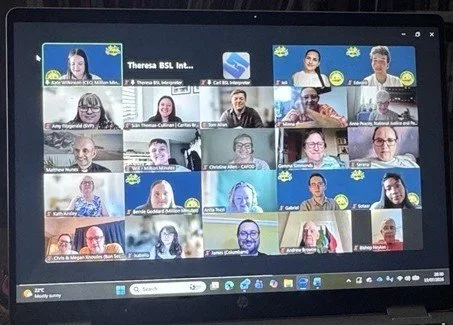
On Wednesday 15th July, the Million Minutes Agents of Change gathered online for In our Own Words, an event designed and led by young people to share their experiences of faith and invite the Church into a deeper conversation about what it means to listen to young people.
Agents of Change is Million Minutes’ youth leadership programme for young people aged 15-18, equipping them to become leaders for peace and justice through formation, mentoring, Catholic Social Teaching and opportunities for advocacy. The online event was the culmination of their journey together.
The event began with an observation shared by the young people themselves: the faith they experience is not always the faith that the world sees.
In a time when Christianity can sometimes be associated with division or exclusion the Agents of Change wanted to offer a different perspective. Their faith, they explained, is rooted in love, service, justice, solidarity and hope.
Rather than adults speaking about young Christians, this was an opportunity for young Christians to speak for themselves. Patrick, Dylan and Emily shared personal reflections on what being a Christian means to them, where they see their faith misunderstood, and how their faith inspired them to love, serve and act.
Their stories were followed by small group conversations, where young leaders and adult participants explore what they had heard.
Participants were asked:
What surprised or challenged you?
Where do you see disconnects between Church perspectives and lived faith?
What does the Church need to gear more clearly from young people?
The conversations were then brough back together by the young leaders, who reflected on the themes emerging across the different groups.
The response from the attendees was incredibly positive. One participant commented on “the depth of knowledge of the faith” demonstrated by the young leaders and their ability to articulate it, while another highlighted their “commitment to their faith and how they were able to clearly articulate what their faith means to them.” Several people spoke about the hope they took away from the event.
At Million Minutes, we believe listening to young people is about more than giving them a microphone. It means creating spaces where their experiences can genuinely shape the conversation. The event gave adults the opportunity to hear directly from young people about their lived experience of faith, while also creating space for dialogue and reflection.
The young leaders had already tested a shorter version of their workshop at the Archdiocese of Liverpool’s Social Action conference earlier in July. Archbishop John Sherrington, who attended their workshop, reflected that the Church needs to create more spaces for young people to be heard and to engage in conversations with adults. He also highlighted that there is much the Church can learn not only from young people’s voices, but from the way they facilitate conversations. The online event built on that experience, bringing together young leaders and adults from across the Church and Catholic social action networks.
The online event concluded by asking participants to identify one concrete action they could take as a result of what they had heard whether it meant listening differently, creating more opportunities for young participation to changing something within their own community.
The response to the Agents of Change programme had left the young people keen to remain involved. Many of the current cohort want to continue contributing to Million Minutes’ work and to help shape the programme for future participants. This is perhaps one of the most exciting outcomes of the project.
Our hope was that the Agents of Change programme wouldn’t simply be a one-off leadership programme but a programme that would help to build a network of young Catholic leaders who are confident in their faith, passionate about justice and equipped to use their voices to make a difference.
As Million Minutes looks towards the next cohort, we want to continue creating opportunities for young people to lead, to question, to challenge, to dream and to act.
Because young people are not simply the future of the Church, they are the Church NOW!
The Archdiocese of Liverpool Social Action Conference
Reflection written by William, Agents of Change young leader and participant in the Social Action Conference
The Liverpool Social Action conference is an annual event in the Archdiocese of Liverpool, bringing together people in faith-based charities, volunteers, and anyone with a particular interest in social justice advocacy and Catholic social teaching. The theme for this year was ‘Humanitas: Flourishing in Action’.

A small group of us met at the cathedral at 8:30 am in the morning, about 1 hour before the conference started we set up our workshop so we were prepared and could focus on the talks. It then got to 9:30 am, we all sat down in our seats and were welcomed by Lucy Raurer, part of the Social Action Team and Archbishop of Liverpool John Sherrington.
The first talk was on ‘The Church of Living Stones’ by Fr Maximillian Martin, who is a Franciscan friar serving as the provincial custos for the Order of Friars Minor Conventual and resides with the Greyfriars in Liverpool. I found the talk really interesting as I was able to learn much more about Saint Francis of Assisi and his life of poverty. The next talk was about ‘From Service to Communion: Exploring Humanitas for Our Time’ by Jenny Sinclair, the founder and director of Together for the Common Good (T4CG) The audience responded well to this, when speaking to people around me about what we heard somebody commented on how they are going to use those messages in their everyday life, everyone engaged well.

After the talks, there were 3 workshops and the first one was called ‘Everyday Human Kindness – Simple Actions for Racial Justice and Community Success’ by Justin Malewezi The founder of The Racial Justice House and a member of the Catholic Association for Racial Justice (CARJ). The next workshop was ‘Why Laudato Si Still Matters – Integral Ecology and Human’ by John Paul de Quay who is the co-founder of the Ecological Conversion Group Charity and The Journey to 2030 Project. The final workshop, which I helped lead was by the Agents of Change Young Leaders, with Million Minutes.
Our workshop was called ‘In Our Words’ During the workshop, wepened with a prayer, by Sotaar and short speeches Firstly by Dylan on ‘Where I see my Faith Misunderstood’ and secondly by Emily on ‘How my Faith Leads me to Love, Serve and Act’ bWe then split into three breakout groups, to discuss what had been heard and then shared our thoughts with the rest of the room. Finally, we finished the workshop with a prayer, lead by myself, thanking all those who had attended the workshops, the Million Minutes team and blessing all the young people who want to have their voices heard.

Following the workshops , we then returned to our chairs where Dcn. John Sargent led a 20-minutes of conversations in the spirit I really enjoyed this as it was a very peaceful way to reflect and consider everything that we had heard. We then had some lunch before heading into the final talk which was called ‘Manifesto for Hope & Our Communities: A Renewed Vision of Human Society’ by Revd. James Green who is the CEO of Together Liverpool, a charity supporting churches and communities to develop practical responses to poverty, exclusion and social need. I really enjoyed reading parts of the manifesto and discussing our own communities and the problems they face.
Next, we had a panel discussion with five panel members, chairing the session was Cllr Jane Corbett, who is the counselor for Everton West Ward. The five panel members were, Professor Iain Buchan who is a professor at The University of Liverpool, Tiffany St James who is the Chief AI officer at the Liverpool City Region, Francis Stewart who is part of the Centre for Catholic Social Thought & Practice (CCSTP), Cllr Portia Fahey who is also a counselor for Everton North Ward, and Jenny Sinclair, Founder and Director of T4CG and the co-host of the Leaving Egypt podcastand Revd. Phil Jump Regional Minister and Team Leader of the North Western Baptist Association and chair of Churches Together in the Merseyside Region (CTMR) Overall, I found the panel very inspiring and noticed that everyone involved interacted with interesting and thoughtful questions.

Finally, Dcn. John Sargent ended the event with a final reflection on the day as a whole and Lucy Raurer thanked us for coming, initiating a round of applause for those who contributed and attended the event.
Refugee Week Prayer Vigil
Reflection written by Ioli, Agents of Change young leader and participant in the Refugee Week event

On the 15th of June we spent a day in London participating in a meaningful programme centred on faith, social justice, and human dignity. Alongside the Columban Missionaries Britain, we joined a peaceful prayer protest advocating for the rights of refugees and asylum seekers. The event provided an opportunity to reflect on our shared values, exploring how the teachings of scripture, the words of prophets, and the examples set by significant religious figures all emphasise compassion, inclusion, and the inherent dignity of every person.

A particularly powerful reflection focused on the fact that Jesus himself experienced life as a refugee. This highlighted the Christian responsibility to welcome and support those forced to flee conflict, persecution, or hardship, while also demonstrating how similar principles of hospitality and justice remain alive today. Listening to different perspectives reinforced the importance of promoting acceptance, understanding, and solidarity in an increasingly divided world.

The experience strengthened my appreciation of the role faith communities can play in advocating for human rights and supporting vulnerable people. It demonstrated that religious belief is not only expressed through worship but also through action, service, and standing alongside those in need. As a memorable reminder of the day, I was also given a spider plant, symbolising growth, care, and new beginnings.

Agents of Change: Rediscovering Hope in a Community of Young Leaders
Reflection written by Ioli, a participant in the Million Minutes Agents of Change: Youth Leadership for Peace and Justice programme.

The Million Minutes Agents of Change leadership residential retreat from the 6th to the 8th of March 2026 was an unforgettable experience, not only because of the progress we made on our final project (more information to come about this soon), but also because of the remarkable people I encountered. Over those few days, I met an array of thoughtful and like-minded young people whose ideas, conversations, and perspectives taught me far more than I could have expected.
Our discussions were guided by several inspiring speakers, including Lucy and Clare from Durham University, Aisling from Pax Christi, and Tom from Million Minutes. Each of them generously shared their knowledge and encouraged us to explore new perspectives on passion, hope, justice, and peace. One particularly fascinating discussion focused on the subtle historical symbolism found in the Bible and how actions can be interpreted in different ways depending on cultural context. For instance, the well-known verse, “If someone strikes you on the right cheek, offer them the left also,” is often interpreted purely as a message of humility. However, when understood within its historical setting, the way a person struck another carried social meaning: a strike with the right palm implied equality, while one with the left suggested disrespect. This deeper understanding challenged me to reflect on how people’s actions are often shaped by their own interpretations of justice.

This conversation led us to consider how individual passions, formed by memories and imagined ideals of the world, can influence how people act on what they believe is right. For example, some individuals may believe that going to war in defence of their religion is justified, while others view even peaceful protest as an extreme measure. Exploring these contrasts encouraged us to question how passion, belief, and memory shape the ways people pursue justice.
During Lucy’s philosophical and theological seminar, we explored the roots of fear and reflected on whether relief can truly be experienced without first knowing fear. This idea draws on the philosophy of St Thomas Aquinas, who argued that good cannot be fully understood in the absence of evil. Building on this, we discussed how hope can be understaff as a powerful human passion or as a theological virtue and considered how meaningful change requires us to “agitate without irritating.” This phrase stayed with many of us and became a guiding idea as we began planning how to structure our event in the summer term.

A passage that resonated deeply throughout the retreat was Matthew 20:25–28: “The Son of Man did not come to be served, but to serve, and to give his life as a ransom for many.” Guided by Bernie and Kate from Million Minutes, we explored how our event could represent, educate, and serve people. Through ‘conversations in the spirit’, I was able to hear incredibly thoughtful, honest, and real ideas from my peers. Their openness and sincerity filled me with hope that together we could create something truly meaningful. By sharing our experiences as Christians, discussing the importance of inclusion, recognising that if you exclude someone, you also exclude all of their ideas and encouraging one another’s contributions, we gradually shaped what began to feel like a genuinely empowering and liberating event.
If I had to choose a single moment that stood out above the rest, it would undoubtedly be the walk to and from Mass, as well as the Mass itself. Before attending the retreat, I hoped that it would help me rediscover a sense of hope in God’s world around me and it truly did. Seeing so many young people deeply committed to their faith yet also open to discussion and reflection was really moving. The peaceful walk through the village that evening sparked beautiful conversations that allowed me to connect more deeply with these inspiring young leaders. It was a moment of genuine connection that I will always remember.

I am immensely grateful to have been given the opportunity to take part in this retreat. It not only strengthened my faith but also reminded me of the power of thoughtful conversation and hopeful passion.